What steel procurement really involves
Steel is the biggest single cost in the structural frame. On a large project, a small percentage on the rate is real money. But a poor decision costs far more later.
- The grade has to match the drawing
- If the consultant specified Fe 550D and you buy Fe 500, that is not a minor swap. It can invalidate the design.
- The paperwork is part of the product
- Tenders, bank appraisals and third-party audits ask for mill test certificates and IS compliance. Without them, the material is unverifiable.
- Delivery timing is a hidden cost
- Late steel forces re-sequenced pours, idle labour and rework. A cheap rate with an unpredictable window is rarely cheap.
The grades that matter, and what they actually do
TMT bars are graded by yield strength: the load they take before they permanently deform. Three grades cover almost all work in Karnataka.
| Grade | Yield min | Elongation min | UTS/YS | Typical use |
|---|---|---|---|---|
| Fe 500 | 500 N/mm² | 12% | ≥ 1.08 | Residential and commercial buildings |
| Fe 550 | 550 N/mm² | 10% | ≥ 1.06 | Heavy-load structures, industrial sheds, demanding frames |
| Fe 550D | 550 N/mm² | 14.5% | ≥ 1.08 | Infrastructure, high-rise, seismic zones |
The D in Fe 550D stands for ductility. Same yield strength as Fe 550, but it stretches further before it breaks, which is what earthquake-prone zones and tall buildings need. Residential work rarely needs more than Fe 500. If your drawing names a grade, do not substitute it.
What sets a reliable TMT supplier apart
Buying from a manufacturer, not a middleman
Buying from the plant gives you one point of accountability. The people who rolled the bar are the ones who tested it, certified it and delivered it.
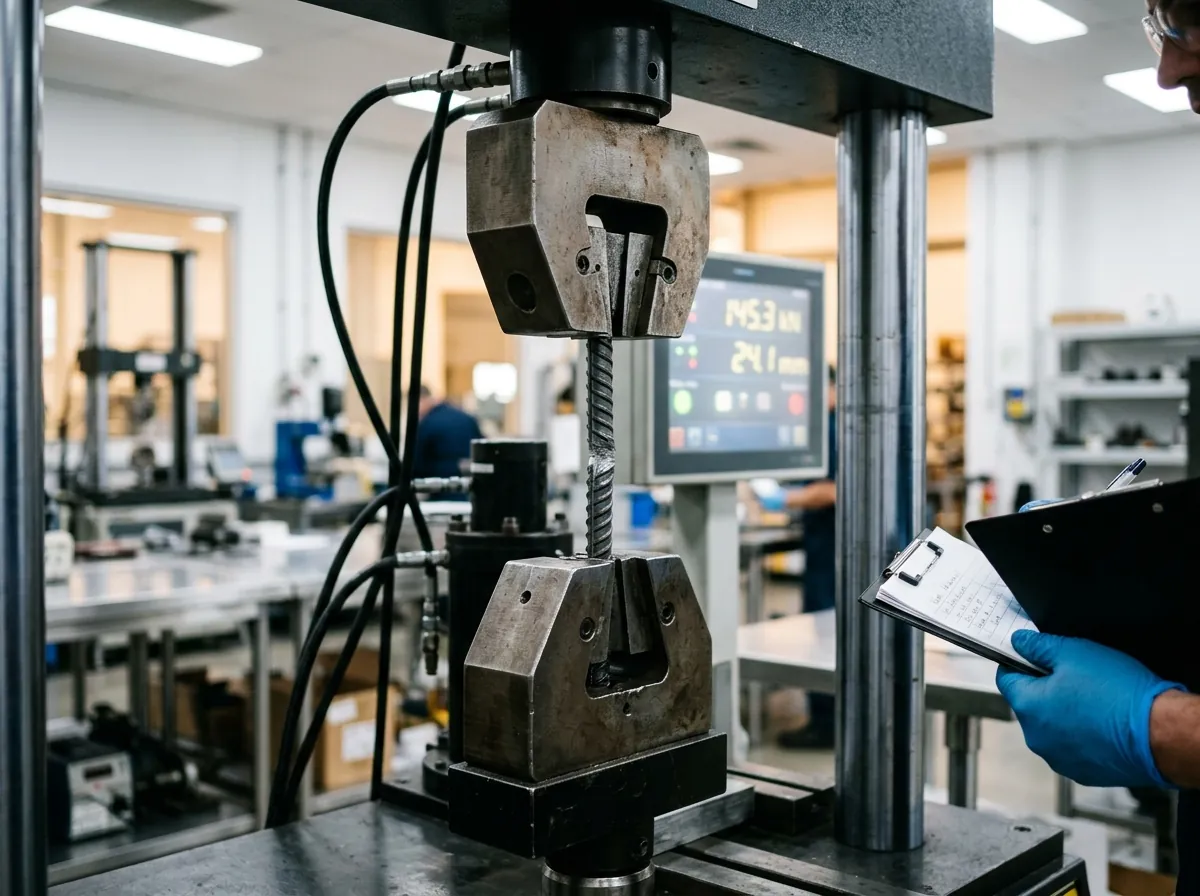
RD TMT makes its bars at our plant in Somanahalli Industrial Area, Maddur Taluk, Mandya: melted, cast, rolled and tested on one site. Every heat is checked in our NABL accredited lab, and every lorry leaves with a test certificate traced to its heat number.
- NABL lab accreditation
- NABLT0826KA18884
- BIS licence, IS 1786
- CM/L-6200193709
- On every dispatch
- Heat number to test certificate
Certifications to ask for
- IS 1786:2008 compliance, the benchmark consultants and auditors check against.
- A BIS ISI licence, proof the bars meet the standard on an audited, ongoing basis. Ours is CM/L-6200193709.
- A NABL accredited lab, so the test certificate comes from an accredited laboratory.
- Green certification where the project needs it. Our Fe 550 bars carry the CII GreenPro Ecolabel (valid till December 2027), and RD TMT bars are rated 5-star Green Steel at 0.63 tonnes of CO2 per tonne.
The physical checks are the marking and the ribs. Genuine bars carry the ISI mark and the maker’s name, with an even rib that gives the concrete its grip. Faint or uneven marking is a red flag. See our certifications.
Why local supply matters in Bengaluru
Our plant is on the Bengaluru–Mysuru Expressway (NH-275), about 80 km from the city, and our registered office is in HSR Layout.
- Predictable delivery windows
- With the plant a short run down the corridor, you can plan deliveries around your pour schedule.
- Lower transport risk
- Short, consistent routes mean less chance of damage, delay or surprise charges on top of the rate.
- A source you can visit
- A plant you can walk into is easier to trust than a warehouse you have never seen.
- The whole city in reach
- Peenya, Nelamangala, Bidadi, Harohalli, Bommasandra and the HSR–Sarjapur belt. See TMT steel delivery.
How to procure TMT steel
Run this on any project before you commit.
- Confirm the grade from the drawing.
Ask your structural consultant. Do not guess.
- Confirm the standard.
Ask for bars made to IS 1786:2008.
- Confirm the sizes.
Common sizes are 8, 10, 12, 16, 20, 25 and 32 mm in 12 m lengths. Fix the mix before you order.
- Verify the source.
Manufacturer or reseller? Can you trace the steel to a plant and a heat number?
- Ask for the certifications.
IS 1786:2008, BIS ISI, NABL lab, and green certificates if the project needs a rating.
- Check elongation as well as strength.
A strong but brittle bar is a liability. Check the figure; do not assume it.
- Get a certificate per load.
Every consignment should come with a certificate showing that batch’s chemistry and strength.
- Plan delivery into the schedule.
Late steel forces re-sequenced pours and idle labour.
- Check the track record.
A local manufacturer with a plant you can visit and projects you can check is easier to hold to account.
Pricing a bar bending schedule
One of the most useful things a supplier can do is price your bar bending schedule (BBS): the breakdown of every bar in the structure by number, size, length, shape and weight.
Priced by size and weight, a BBS is far more accurate than a general per-tonne rate, because it reflects the actual size mix your project needs. It gives you a tighter budget before you commit. We price a BBS within one business day. See bulk TMT bar supply.
Frequently asked questions
What grade of TMT bar should I use for a residential project?
Most homes and low-rise buildings work well with Fe 500. If your structural consultant has specified a higher grade, follow the drawing.
What is the difference between Fe 550 and Fe 550D?
Both have a minimum yield strength of 550 N/mm². The D stands for ductility: Fe 550D has higher elongation, which suits seismic zones and structures that must bend without breaking.
Are RD TMT bars made to IS 1786:2008?
Yes. Our bars are made to IS 1786:2008, and each consignment is checked before dispatch.
Do you provide a test certificate with every load?
Yes. Every lorry leaves with a test certificate from our NABL accredited lab, showing the chemistry and strength of that batch, traced to its heat number.
Is RD TMT approved for government projects?
Yes. Tamil Nadu PWD, Karnataka Power Corporation, the Bangalore Development Authority, Chennai Metro Rail and Karnataka PWD have approved our bars. KRIDL, DRDA Madurai and AP State Housing Corporation have bought them through tender.
What sizes are available?
8, 10, 12, 16, 20, 25 and 32 mm TMT bars in 12 m lengths, plus MS billets in 100, 110, 125 and 150 mm square sections.
Where do you deliver?
Across Karnataka, Tamil Nadu and Andhra Pradesh from our plant in Mandya, near Bengaluru and Mysuru, with pan-India delivery for large projects.
Can you price my bar bending schedule?
Yes. Send your bar bending schedule and we will price it by size and weight within one business day.
What is the minimum order quantity?
It depends on the grade, size mix and site. Send the quantity you need and we will quote within one business day.