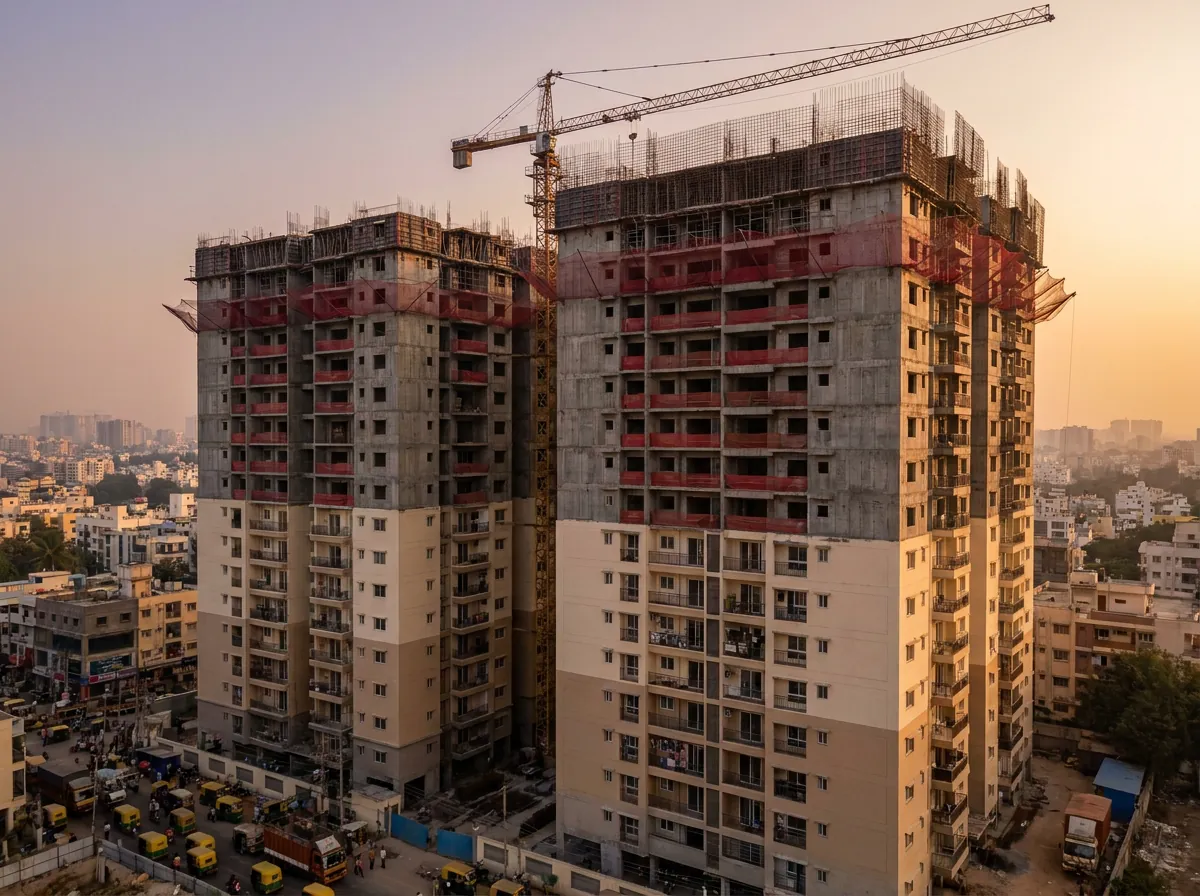
Why high-rise TMT is not house TMT
- Volume. A tower takes thousands of tonnes of steel over its build, not the few tonnes of a house.
- Duration. The project runs for years. The supplier has to hold the same grade and size mix across the whole period.
- Mix. Footings, core walls, columns and slabs can each call for a different grade, element by element.
- Seismic behaviour. A tall building sways. Under an earthquake it has to bend and absorb energy, not crack.
- Paperwork. Consultants, auditors and tender committees ask for heat-level traceability and test certificates. On a tower it is a condition of sign-off.
The practical result: a high-rise needs a steel supplier who works like a project partner, not a yard that happens to have bars in stock.
The grades that carry a high-rise
All three grades are made to IS 1786:2008. The difference is strength and ductility.
| Grade | Yield min | Elongation min | UTS/YS | In a high-rise |
|---|---|---|---|---|
| Fe 550 | 550 N/mm² | 10% | ≥ 1.06 | Columns, footings, heavy-load elements |
| Fe 550D | 550 N/mm² | 14.5% | ≥ 1.08 | Ductile detailing, core walls, higher seismic zones |
| Fe 500 | 500 N/mm² | 12% | ≥ 1.08 | Slabs and secondary elements |
The "D" is a ductility requirement. Fe 550D has the same yield strength as Fe 550 but stretches to 14.5% before it fails, against 10%. That extra stretch is what lets a structure in a higher seismic zone absorb earthquake energy without a sudden fracture.
Which grade goes where
- Footings and plinth beams: Fe 550, where the design calls for it.
- Columns and core walls: Fe 550, or Fe 550D where the design specifies ductile detailing.
- Beams: Fe 550 or Fe 550D, as the design states.
- Slabs: Fe 500 or Fe 550. Slabs are rarely the strength-critical element.
- Special moment-resisting frames in higher zones: Fe 550D is the usual choice.
The grade is a design decision. Do not specify Fe 550 everywhere "to be safe". It adds cost, and too little ductility where the code expects it is a structural problem, not a price problem.
What the codes say about tall buildings
- IS 16700:2017, criteria for the structural safety of tall concrete buildings. It sets the extra structural and serviceability rules once a building is tall.
- IS 1893 (Part 1):2016, seismic design. It assigns the seismic zone and sets when ductile detailing applies.
- IS 13920:2016, ductile detailing of reinforced concrete. It asks for reinforcement with at least 14.5% elongation, which Fe 550D meets.
- IS 456:2000, plain and reinforced concrete: lapping, cover and development length.
- IS 875 (Part 3), wind loads, which shape the lateral system and the core steel.
- IS 1786:2008, the bar standard that defines Fe 500, Fe 550 and Fe 550D.
Under IS 1893, Bengaluru is in Seismic Zone II and Chennai and Coimbatore are in Zone III. Zone III work pushes harder toward ductile detailing and Fe 550D. The zone on your design document drives the grade, not the city’s reputation.
How high-rise projects actually source steel
Lift schedules, not one-off orders
A high-rise buys against a lift schedule: deliveries matched to the build, footings first, then columns and slabs floor by floor. So the questions to ask a supplier change.
- Can you hold the grade mix?
Fe 550 and Fe 550D, 8 mm to 32 mm, for the life of the project.
- Can you deliver to the schedule?
Monthly or fortnightly lifts, without gaps.
- How is the rate quoted?
On quantity, size mix and timeline, with a clear validity.
- Does every load come with a certificate?
A test certificate tied to the heat number, every delivery.
The documentation that clears a tender
On a government or consultant-led tower, the paperwork is part of the product: the ISI mark and licence number (CM/L-6200193709), a NABL test certificate per batch (lab NABLT0826KA18884), the GreenPro certificate where the project has a green target, and the approval letter where the work is under PWD, BDA or a metro authority.
Where RD TMT fits
Quenched and self-tempered, not cold-twisted
RD TMT bars are rolled on German TEMPCORE lines. The bar is quenched with water to harden the outer layer, then self-tempers from the core. The result is a strong outer layer and a ductile core, the combination a tall building needs under cyclic load.
Every dispatch tested, every bar traceable
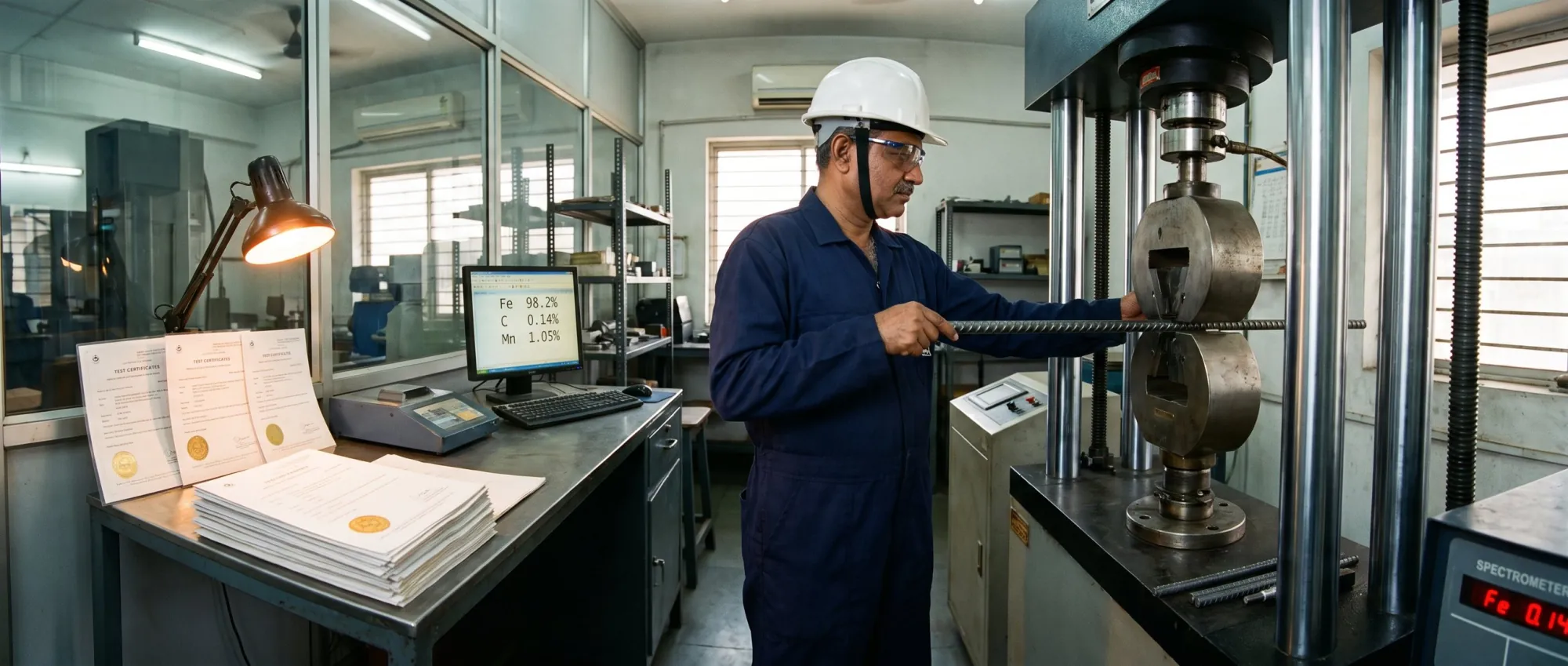
Every batch is tested in our NABL accredited lab. Each dispatch leaves with a test certificate tied to a heat number, so a bar on the 30th floor can be traced back to its melt.
- NABL lab accreditation
- NABLT0826KA18884
- BIS licence, IS 1786
- CM/L-6200193709
- On every dispatch
- Heat number to test certificate
The GreenPro certificate
Our Fe 550 bars carry the CII GreenPro Ecolabel in all seven sizes (GPRDT496001 to GPRDT496007, valid till December 2027), and RD TMT bars are rated 5-star Green Steel by the Ministry of Steel at 0.63 tonnes of CO2 per tonne. For a tower with IGBC, LEED or GRIHA targets, that is a certificate with a number and a date. See our certifications.
Buying TMT for a high-rise in Bengaluru and Karnataka
RD TMT supplies construction companies, contractors, dealers and government projects across Karnataka and South India. For a high-rise, supply is arranged as a project.
- Quoted for the project
- Rates quoted on quantity, size mix and timeline, not only on today’s market rate.
- Delivered to your lifts
- Deliveries planned against your lift schedule, each with the NABL certificate for its heat.
Our plant is in Mandya on the Bengaluru–Mysuru corridor, and our registered office is in HSR Layout, Bengaluru. Bars come in 12 m standard length. See bulk TMT bar supply for how phased delivery works.
A high-rise TMT checklist for site engineers and procurement teams
- Confirm the grade element by element.
Fe 550 for strength-critical members, Fe 550D where the design calls for ductile detailing.
- Check the grade on the tag.
It should read Fe 550 or Fe 550D, matching the drawing.
- Verify the ISI mark.
The ISI mark on the bar, and licence CM/L-6200193709 on the paperwork.
- Match certificate to heat.
Match the NABL test certificate to the heat number on every delivery.
- Weigh a bar.
Check it against IS 1786 Table 1: 1.580 kg/m for 16 mm, 3.850 kg/m for 25 mm.
- Bend a sample.
Do a bend and rebend check before the bar is placed.
- Inspect the surface.
Look for cracks, deep scale or rust pitting.
- Confirm the splicing plan.
For 25 mm and above, lap lengths per the design, or mechanical splices where the detail needs them.
If any of these fail, stop and check before the bar goes into the concrete.
Frequently asked questions
Which TMT grade is best for a high-rise building?
Fe 550 for strength-critical elements such as columns, footings and core walls, and Fe 550D where the design calls for ductile detailing. Slabs and secondary elements are often Fe 500. The structural design decides, element by element.
What is the difference between Fe 550 and Fe 550D?
Both have a minimum yield strength of 550 N/mm². Fe 550D stretches more, 14.5% elongation against 10%, and has a higher UTS/YS ratio, 1.08 against 1.06. That ductility is what IS 13920 detailing asks for.
Is Fe 550D mandatory for high-rise buildings?
No. It depends on the seismic zone and the design. Where IS 13920 ductile detailing applies, the bars must meet its 14.5% elongation requirement, which Fe 550D does. In Zone II, such as Bengaluru, Fe 550 often covers the design.
Which code covers tall concrete buildings?
IS 16700:2017 sets the criteria for the structural safety of tall concrete buildings. IS 13920:2016 covers ductile detailing, and IS 1893 covers seismic design.
Can Fe 500 be used in a high-rise?
Yes, where the design allows it, typically in slabs and secondary elements.
What documentation should a high-rise TMT supplier provide?
The ISI mark on the bar and the licence number, a NABL test certificate per batch tied to the heat number, and where needed the GreenPro certificate and the relevant approval letters.
Which seismic zone is Bengaluru in?
Bengaluru is in Seismic Zone II under IS 1893. Chennai and Coimbatore are in Zone III.
Does RD TMT supply multi-year projects?
Yes. Supply is planned against the project’s lift schedule, quoted on quantity and timeline, with a NABL test certificate for every batch.
How do I get a quote?
Send the grades, sizes, quantities and the project timeline. We will quote for delivery to your site in Bengaluru, Karnataka or across South India.