What is an Fe 500 TMT bar?
An Fe 500 bar is a reinforcement bar that does not start to stretch permanently until the stress on it reaches 500 N/mm². That number is the single most important thing about the grade, because it decides how much steel a design needs.
TMT stands for Thermo-Mechanically Treated. A TMT bar is quenched with water as it leaves the rolling mill, then left to cool. This gives it two properties in one bar: a hard outer layer for strength and grip, and a soft, ductile core so it can bend and rebend without cracking. A cold-twisted bar has strength but not the same ductility. That difference matters the day your site has to make a bend the drawing forgot.
Fe 500 TMT bars are made to IS 1786:2008, the Indian Standard for high strength deformed steel bars. A structural consultant, a government tender and a third-party auditor all check against it. If a supplier cannot name the standard their bars are made to, that is your first warning sign.
Fe 500 TMT bar specifications
RD TMT makes Fe 500 bars to IS 1786:2008, in every size from 8 mm to 32 mm. These are the values a designer works from.
| Mechanical | |
|---|---|
| Yield strength | 500 N/mm² min |
| Elongation | 12% min |
| UTS / YS ratio | 1.08 min |
| Chemistry | |
| Carbon | 0.30% max |
| Sulphur | 0.055% max |
| Phosphorus | 0.055% max |
| Sulphur + phosphorus | 0.105% max |
| Supply | |
| Standard | IS 1786:2008 |
| Diameters | 8, 10, 12, 16, 20, 25, 32 mm |
| Length | 12 m standard |
Elongation is the one buyers skip, and the one that matters most for safety. It is how far the bar stretches before it breaks. A higher elongation means the structure gives warning before it fails, and it flexes instead of snapping. Fe 500 gives 12%. When a project needs more than that, you move up to a ductile grade.
Fe 500 vs Fe 550 vs Fe 550D
The three grades we make are not better or worse than each other. They are for different jobs.
| Grade | Yield min | Elongation min | UTS/YS | Typical use |
|---|---|---|---|---|
| Fe 500This page | 500 N/mm² | 12% | ≥ 1.08 | Houses, apartments, general RCC |
| Fe 550 | 550 N/mm² | 10% | ≥ 1.06 | High-rise, heavy load, government works |
| Fe 550D | 550 N/mm² | 14.5% | ≥ 1.08 | Seismic zones, ductile detailing, infrastructure |
- Fe 500 is the workhorse for residential and general construction. It balances strength and cost, and it covers the largest share of everyday RCC work.
- Fe 550 has a higher yield strength, so a design needs less steel to carry the same load. It suits high-rise and heavy-load structures, and it is the grade most of our government approvals name.
- Fe 550D TMT bars keep the strength of Fe 550 but raise elongation to 14.5%. They are the ductile grade for seismic zones and ductile detailing, where the structure has to bend without breaking.
If you are building a home on a plot in Bengaluru or Mysuru, Fe 500 is normally the right call. If a structural consultant has specified a ductile grade for a seismic zone, or a tender names Fe 550D, do not substitute. The grade is in the drawing for a reason. Our team will tell you if a grade does not fit your drawing. We would rather flag it before the steel reaches site than after. Compare all three grades.
Sizes and weights
Size is about where the bar sits in the structure. The weight per metre follows the size, and it is the number a bar bending schedule is priced on.
| Size | Weight per metre | Typical use |
|---|---|---|
| 8 mm | 0.395 kg/m | Ties and stirrups |
| 10 mm | 0.617 kg/m | Slabs, distribution steel |
| 12 mm | 0.888 kg/m | Beams and slabs |
| 16 mm | 1.580 kg/m | Beams and columns |
| 20 mm | 2.470 kg/m | Columns |
| 25 mm | 3.850 kg/m | Footings |
| 32 mm | 6.310 kg/m | Heavy structures |
We supply all seven sizes in Fe 500, in 12 m standard length. Send our team your bar bending schedule and we will price it. See the full TMT bar sizes and weights for every grade.
How RD TMT makes Fe 500 bars
Quenched and self-tempered, not cold-twisted
A TMT bar gets its properties from the way it cools. As the hot bar leaves the rolling mill, high-pressure water quenches the surface. This forms a hard, martensitic outer layer. The core stays hotter and cools more slowly, so it stays soft and ductile. The heat from the core then tempers the outer layer from the inside.
That is why a TMT bar can be strong and bendable at the same time. Cold-twisted bars get their strength by twisting, which uses up most of their ductility. For a structure in a seismic zone, or one that has to absorb movement, the TMT process is the better choice.
Every dispatch tested, every bar traceable
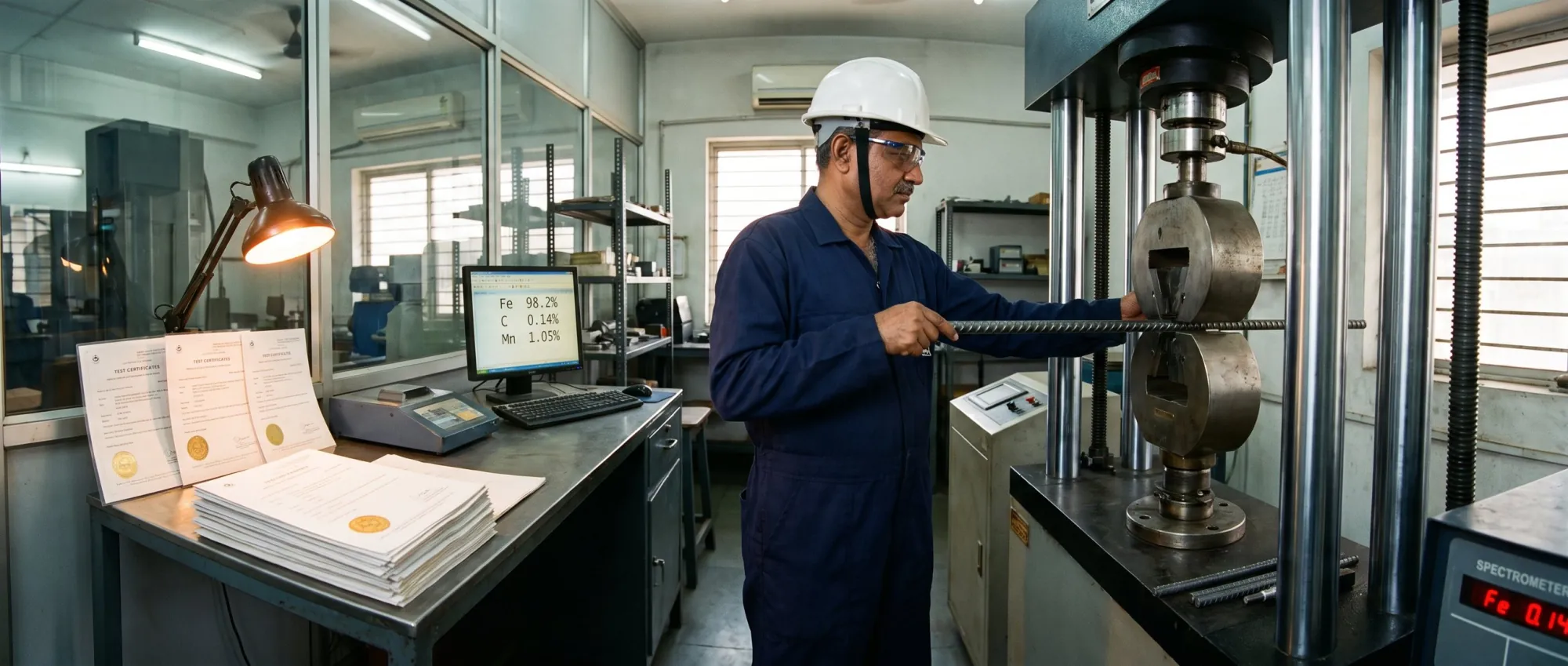
Our in-plant lab is NABL accredited to ISO/IEC 17025:2017. Every lot is tested there before it leaves, for yield strength, elongation, the UTS/YS ratio and chemistry.
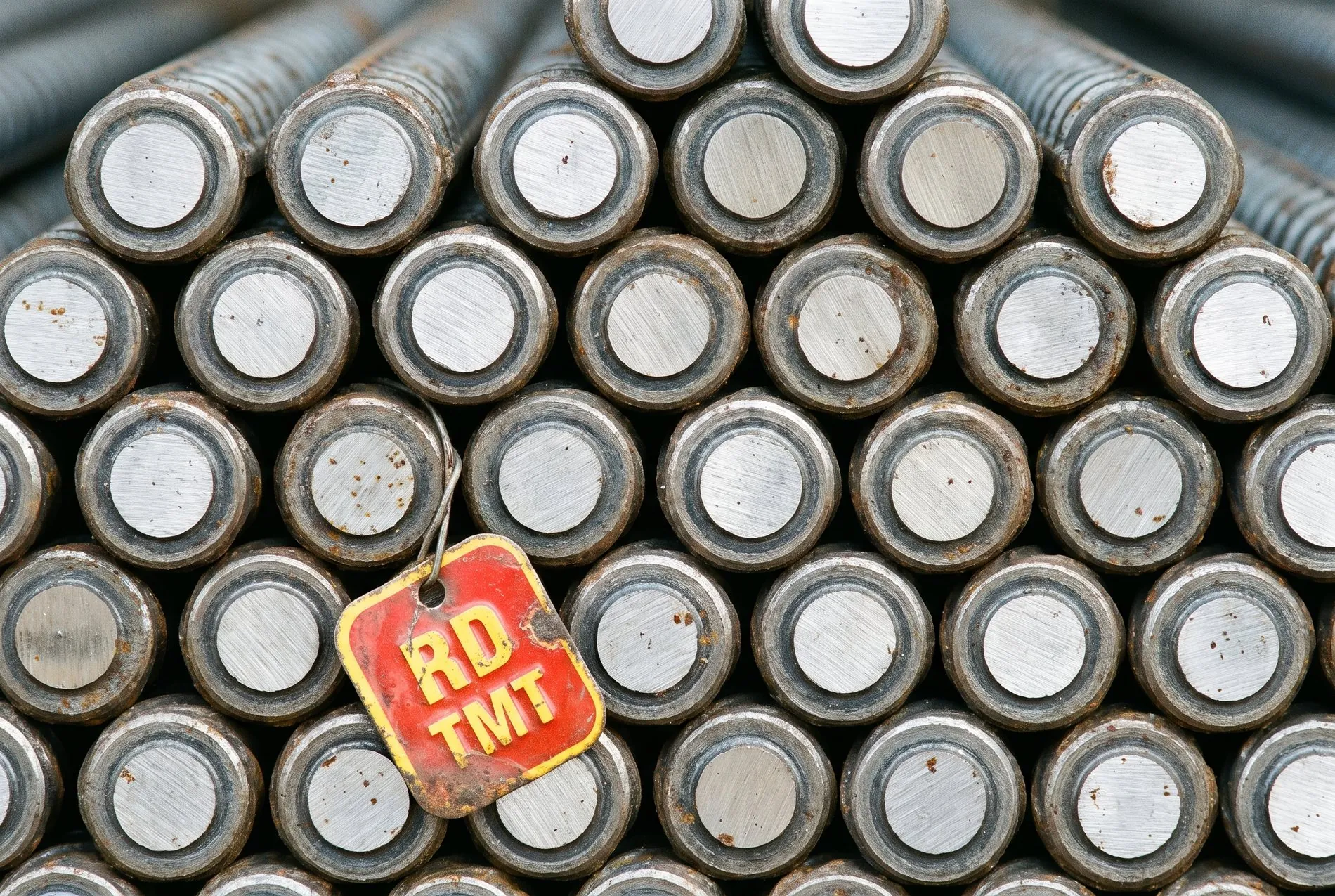
Each bundle leaves with a tag that carries a heat number. That heat number links the bundle to its test certificate. So if a site engineer wants to know what is inside a bar, the paper trail is there.
Every bar also carries the RD TMT name and the ISI mark. That marking stays on the bar long after the tag has come off the bundle. Read how we make our bars at Somanahalli, or open our certifications.
- NABL lab accreditation
- NABLT0826KA18884
- BIS licence, IS 1786
- CM/L-6200193709
- On every bundle
- Heat number to test certificate
Where Fe 500 bars are used
IS 1786 does not decide where a grade goes. The design does. But there are clear patterns in the projects Fe 500 suits best.
Houses and apartments
Fe 500 is the default grade for independent houses, apartment blocks and general RCC frames. It gives the yield strength a residential design needs at a sensible cost. Slabs, beams, columns and footings in a home are usually Fe 500, unless the consultant has specified a ductile grade for a seismic zone.
- Ties and stirrups
- 8 mm
- Slabs and beams
- 10–12 mm
- Beams and columns
- 16 mm
- Columns and footings
- 20–25 mm
A bar bending schedule from your structural consultant sets the exact mix.
Institutional and industrial buildings
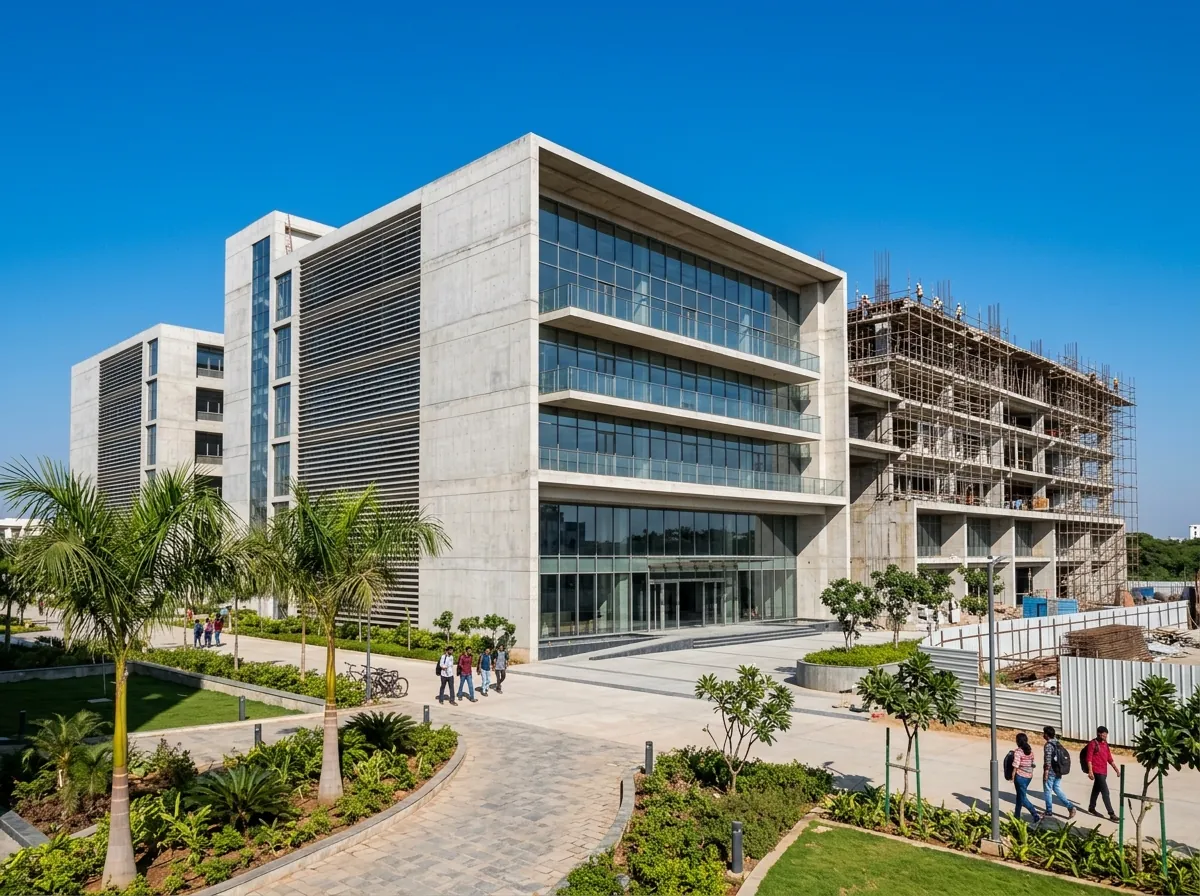
Fe 500 and Fe 550 both suit institutional and industrial buildings: campuses, schools, factory buildings and similar structures. Where the loads are heavier or the spans are longer, Fe 550 usually takes over, because a higher yield strength means less steel for the same job. Where the work is conventional, Fe 500 stays the economical choice.
If your project is a school, a hospital block, a factory shed or a warehouse, tell us the structure and send the drawings. We will help you match the grade to the load rather than guess. See the projects we supply.
Buying Fe 500 TMT bars in Bengaluru and Karnataka
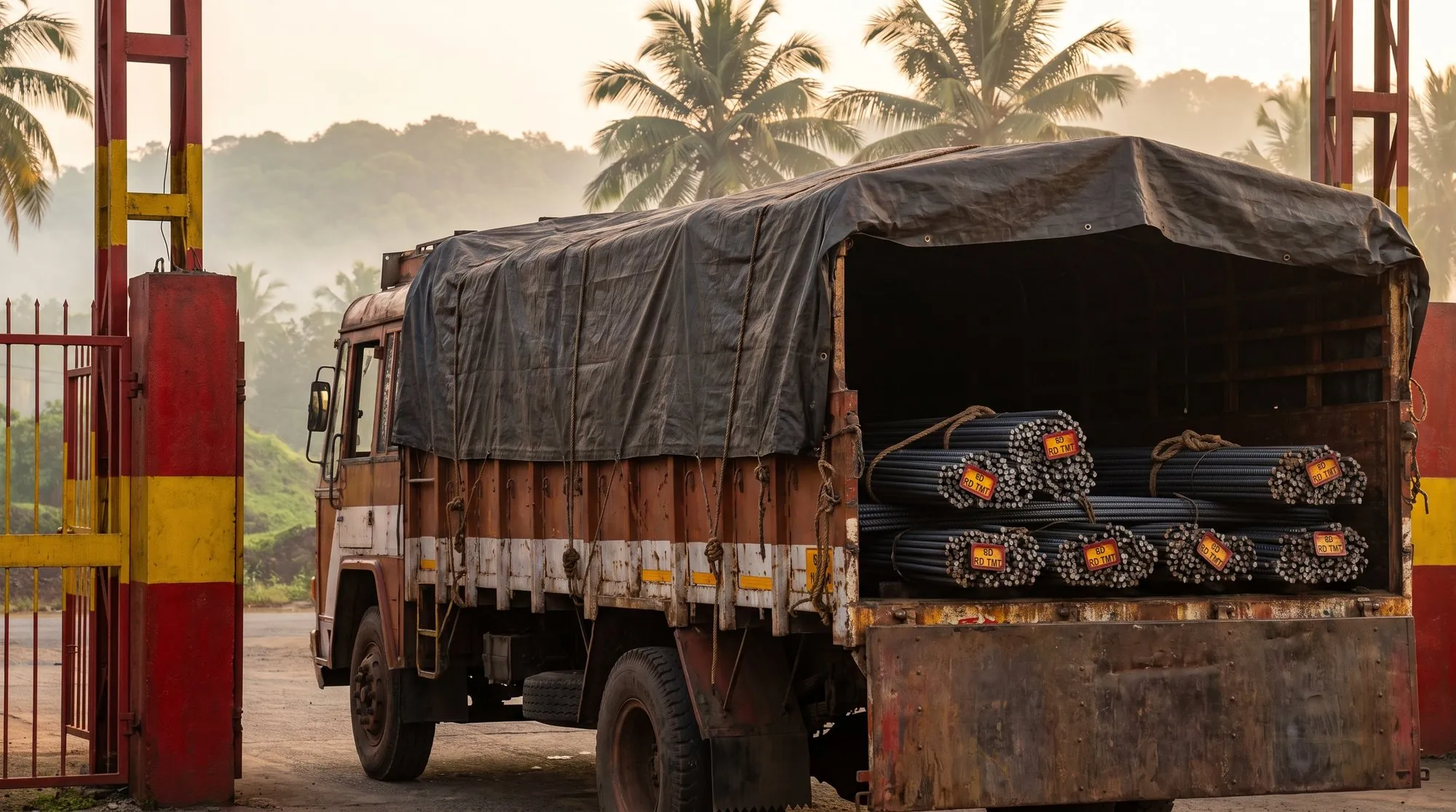
RD TMT sells to builders, contractors, dealers and government projects across Karnataka and South India. Our plant is at Somanahalli Industrial Area, Maddur Taluk, Mandya District, on the Bengaluru–Mysuru corridor (NH-275). Our registered office is in HSR Layout, Bengaluru. That keeps delivery practical across the city and out to project sites across the state.
- Proximity
- A plant on the Bengaluru–Mysuru corridor keeps haulage short and delivery windows predictable. Steel that arrives on time keeps a pour on schedule.
- One standard, one source
- We manufacture and we test. The bar that leaves our plant is the bar our lab certified, with the heat number to prove it. There is no middleman between the mill and your site.
If you are a contractor with a rolling requirement, we plan delivery dates with you around your construction schedule, so you are not storing steel you are not ready to place.
A simple Fe 500 bar checklist for site engineers
Six things to check before you accept a bundle of Fe 500 bars. This does not replace your test certificate. It is what you can confirm on the spot.
- Check the grade on the tag.
The bundle tag names the grade. Check it says Fe 500 and matches your drawing.
- Look for the name and the ISI mark.
Every RD TMT bar carries the RD TMT name and the ISI mark. Only a supplier with a BIS licence can use the mark. Ours is CM/L-6200193709.
- Match the heat number.
Each bundle tag carries a heat number. That number links to the test certificate. Ask for the certificate and match the numbers.
- Check the rib pattern.
Ribs should be the same along the length and from bar to bar, so the bond with concrete is the same throughout.
- Look at the cut ends.
A TMT bar has a hard outer ring and a softer, ductile core. A cut end shows the two as a darker ring around a lighter centre.
- Weigh a sample.
The weight per metre should match IS 1786 Table 1. An undersized bar does not do the job the drawing expects.
If a bundle fails any of these, stop and ask. It is far cheaper to raise a question at the gate than to cut out steel later.
Frequently asked questions
What is an Fe 500 TMT bar?
An Fe 500 TMT bar is a thermo-mechanically treated reinforcement bar with a minimum yield strength of 500 N/mm², made to IS 1786:2008. It is the standard grade for houses, apartments and general RCC work.
What is the yield strength of Fe 500?
Fe 500 has a minimum yield strength of 500 N/mm², a minimum elongation of 12% and a minimum UTS/YS ratio of 1.08.
What is the difference between Fe 500 and Fe 550?
Fe 550 has a higher minimum yield strength, 550 N/mm² against 500 N/mm², so a design needs less steel to carry the same load. It suits high-rise, heavy-load and government work. Fe 500 is the more economical choice for general residential construction.
Is Fe 500 good for house construction?
Yes. Fe 500 is the default grade for independent houses and apartment blocks. If your structural consultant has specified a ductile grade for a seismic zone, follow the drawing instead.
What sizes does Fe 500 come in?
We supply Fe 500 in 8, 10, 12, 16, 20, 25 and 32 mm, in 12 m standard length.
What is the price of Fe 500 TMT bars in Bengaluru?
Price depends on the size, the quantity and the current market rate. Share your requirement and we will give you a current quote rather than a guess.
Are RD TMT's Fe 500 bars BIS certified?
Yes. Our bars are made to IS 1786:2008 and carry the ISI mark under BIS licence CM/L-6200193709.
How do I know the Fe 500 bar on site is genuine?
Check the RD TMT name and the ISI mark on the bar, check the grade on the bundle tag, and match the heat number on the tag to its NABL lab test certificate.
Do you deliver Fe 500 bars across Karnataka?
Yes. We deliver across Bengaluru and to project sites across Karnataka and South India, from our plant on the Bengaluru–Mysuru corridor.
How do I get a quote for Fe 500 TMT bars?
Send us your bar bending schedule, or just the sizes, tonnage and site. Our sales team will price it within one business day.