Manufacturer, stockist, dealer, trader: four different things
People use these words as if they mean the same. They do not, and the difference decides who you can hold to account when something goes wrong.
- A manufacturer melts, casts, rolls and tests the steel. It owns the quality, the grade and the chemistry.
- A stockist holds inventory on the ground. The value is availability: a size mix quickly, in smaller quantities than a full production run.
- A dealer is the supply channel. They take your requirement, price it and get it to your site on a schedule.
- A trader or broker buys and sells without touching the material. Nothing wrong with that, but nobody in the chain owns the quality.
Why the difference shows up on your invoice
Buy from a broker and the test certificate you finally get may be a copy of a copy. If a bar fails a bend test on site, you are talking to someone who has never seen the plant. Buy from the manufacturer, or a dealer backed by one, and the paperwork traces back to a heat number a lab actually recorded.
The best arrangement is a manufacturer who also sells direct to dealers and contractors: a direct-source price, real availability, and a named person who can answer for the steel.
What a good TMT bar dealer actually does
A competent dealer does these seven things. If two or three are missing, you are dealing with a broker.
- Prices your bar bending schedule.
You send the schedule; they return a quote by size and weight, not a per-kilo rate that changes at delivery.
- Gives grade advice, with a reason.
A good dealer says when Fe 500 is enough and when you need the ductile grade.
- Plans the delivery around your pour.
A date and time band tied to your schedule, not "we will dispatch Tuesday".
- Sends a test certificate with the load.
Traced to the heat number of the steel you received.
- Supplies the documents your project needs.
Government approvals and tender experience matter for departments, metros and housing schemes.
- Handles mixed size orders.
A boundary wall and a raft foundation do not want the same order.
- Supports retail traders properly.
Consistent supply and rates that let a shop keep a margin without guessing.
For the full range a dealer should be able to quote, see the TMT bar products page.
Why stocking steel in Karnataka is harder than it looks
- Working capital sits on the ground
- Inventory is money in the yard. Over-stock and you lose to interest and storage. Under-stock and you lose the customer who needed 12 mm that afternoon.
- Prices move faster than quotes
- TMT rates track scrap and sponge iron, so serious suppliers quote against a stated validity and the current rate, not a price list that goes stale.
- Size mix is a guessing game
- Every size has a different buyer. Too much 32 mm can sit for a year; too little 8 mm loses every small builder nearby.
- Freight and credit bite
- The run from plant to site is not free, and the trade runs on credit. A rate that looks too low is often recovered later through weight or grade.
This is why a nearby plant matters. Steel made on the Bengaluru–Mysuru corridor reaches Bengaluru, Mandya and Mysuru sites within a workable window. That shortens the cash cycle and makes a delivery promise something a dealer can keep.
Size mix: what a serious stockist keeps on the ground
| Size | Where it goes | Who usually buys it |
|---|---|---|
| 8 and 10 mm | Stirrups, distribution steel, light residential | Small builders, retail shops |
| 12 and 16 mm | Beams, columns and slabs in homes and low-rise | Residential developers, site contractors |
| 20 and 25 mm | Heavy columns, rafts, industrial structures | Industrial contractors, RMC-linked projects |
| 32 mm | Bridges, flyovers, large pours | Infrastructure and EPC contractors |
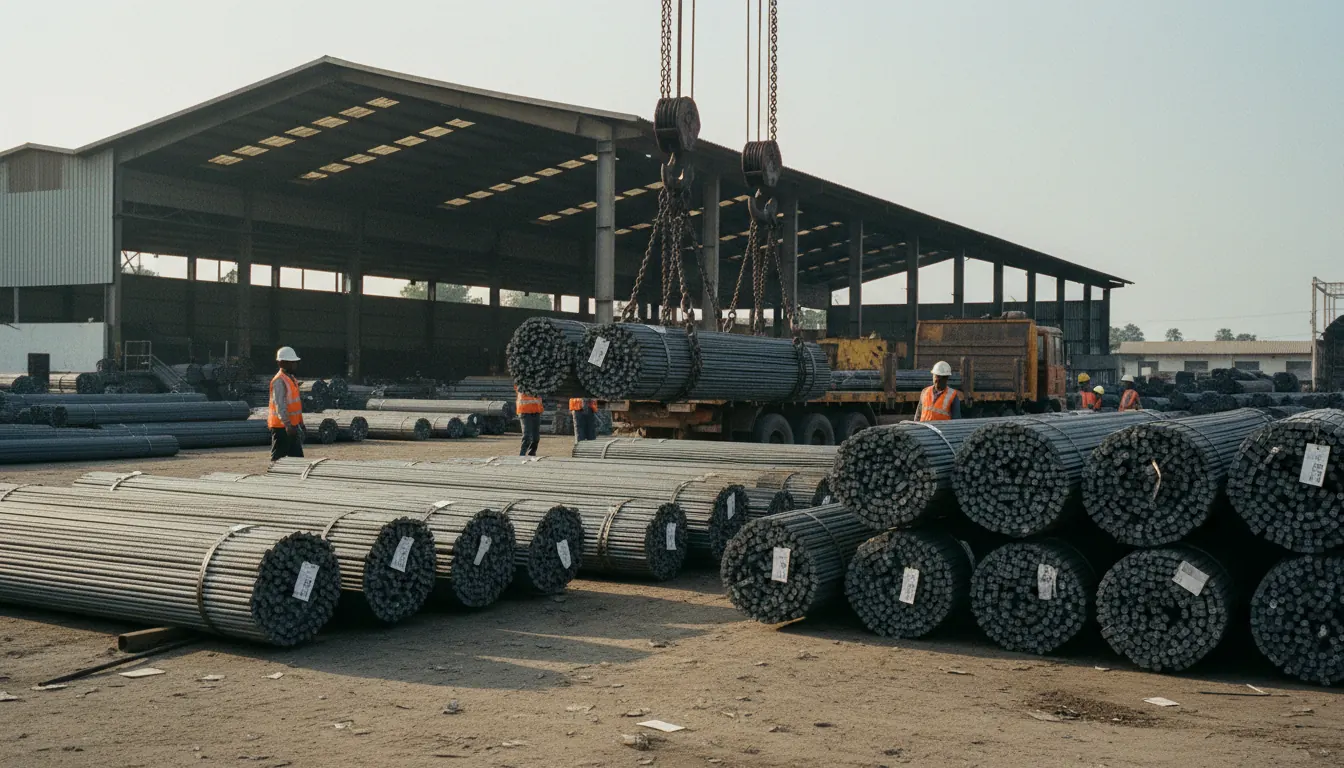
RD TMT makes all seven sizes, 8, 10, 12, 16, 20, 25 and 32 mm, in 12 m lengths, so a size mix does not have to be pieced together from three suppliers. See TMT bar sizes and weights.
Matching grade to structure
| Grade | Yield min | Elongation min | UTS/YS | Typical use |
|---|---|---|---|---|
| Fe 500 | 500 N/mm² | 12% | ≥ 1.08 | Residential and commercial buildings |
| Fe 550 | 550 N/mm² | 10% | ≥ 1.06 | Heavy-load structures, industrial sheds |
| Fe 550D | 550 N/mm² | 14.5% | ≥ 1.08 | Infrastructure, high-rise, seismic zones |
The D in Fe 550D stands for ductility. The higher elongation is what an engineer asks for when a building must bend in an earthquake rather than snap.
The fifteen-minute dealer verification checklist
Do this once, before your first order. It takes fifteen minutes and can save you a failed load.
- Look at the bar, not the brochure.
Check the ISI mark and the maker’s name on the bar, and the grade on the bundle tag.
- Ask for the certificate for your heat.
Match the heat number on the certificate to the tag. A certificate for a different heat is paper, not proof.
- Confirm the lab.
An in-house lab accredited to ISO/IEC 17025 is the strongest version. Ask which lab, and see the accreditation.
- Check elongation, not just strength.
A strong but brittle bar is a liability in any structural member.
- Weigh a bundle.
Compare actual against nominal weight. Persistent short weight is the quietest way a buyer loses money.
- Measure a bar.
A caliper on three bars from the bundle settles the size question in seconds.
- Check the certification scope.
Certificates cover specific grades and sizes. For example, our GreenPro Ecolabel covers Fe 550 bars, 8 to 32 mm.
- Get the delivery window in writing.
A date and time band tied to your pour. "Soon" is not a window.
The certifications page lists the lab and licence details behind every RD TMT load.
Four mistakes that cost contractors money
- Buying on rate alone. Once you add short weight, late delivery or a grade swap found at the pour, the lowest rate was never low.
- Accepting a certificate without matching the heat number. The most common failure, and the easiest to catch.
- Over-specifying grade to feel safe. Fe 550D is right for a seismic zone or a high-rise. For a compound wall, it is money spent on nothing.
- Ordering the full quantity at once. Phased deliveries protect your cash flow and your yard space. A supplier who cannot phase is just a dispatcher.
What RD TMT offers dealers and stockists
RD TMT is a manufacturer that sells direct to dealers, contractors, developers and government buyers. The people quoting your rate are the people who made the steel.
- Bulk supply and bar bending schedule pricing, priced by size and weight within one business day.
- Dealer and stockist support for retailers across Karnataka, including grade-specific supply when a customer’s drawing calls for it.
- A test certificate with every load from our NABL accredited lab, traced to its heat number.
- Delivery across Bengaluru’s corridors: Peenya, Nelamangala, Bidadi, Harohalli, Bommasandra and the HSR–Sarjapur belt, and out to Mandya, Mysuru and the wider state.
- Documents that survive scrutiny: BIS licence to IS 1786:2008, ISO 9001, 14001 and 45001 systems, and the CII GreenPro Ecolabel for Fe 550 bars, 8 to 32 mm, valid till December 2027.
- 5-star Green Steel from the Ministry of Steel, at 0.63 tonnes of CO2 per tonne.
- Government approvals from Tamil Nadu PWD, KPCL, the Bangalore Development Authority, Chennai Metro Rail and Karnataka PWD, and tenders won through KRIDL, DRDA Madurai and APSHCL.
- Annual capacity
- 2.5L+ MT
- Made and certified, FY 2025-26
- 63,614 MT
- Founded
- 2013
Read more about the plant and the team on the about page.
Where the steel comes from
- Plant
- Plot No. 16C/1, Somanahalli Industrial Area, Maddur Taluk, Mandya District, Karnataka 571429. On the Bengaluru–Mysuru road, about 80 km from Bengaluru.
- Sales and documents
- Ground Floor, HANTO Building, No. 17/L, 18th Cross, Sector 3, HSR Layout, Bengaluru 560102.
Phone +91 63649 63636, email rdtmtin@gmail.com, or use the contact page.
Frequently asked questions
What is the difference between a TMT bar dealer and a stockist?
A stockist holds inventory, so you can get a size mix quickly. A dealer prices your requirement and schedules delivery. A manufacturer selling direct can cover both.
Which TMT grades can I buy in Karnataka?
RD TMT makes Fe 500, Fe 550 and Fe 550D, all to IS 1786:2008, in sizes from 8 mm to 32 mm. Fe 550D is the ductile grade for seismic work.
What sizes are available?
8, 10, 12, 16, 20, 25 and 32 mm TMT bars in 12 m lengths. MS billets in 100, 110, 125 and 150 mm square sections.
Do I get a test certificate with every load?
Yes. Every lorry leaves with a test certificate from our NABL accredited lab, showing the chemistry and strength of that batch, traced to its heat number.
Can a dealer supply a small quantity for a small site?
Minimum order depends on the grade, size mix and site. Share the quantity you need and you will get a quote within one business day.
Can you price my bar bending schedule?
Yes. Send the schedule and it is priced by size and weight within one business day.
Which areas do you deliver to?
Karnataka, Tamil Nadu and Andhra Pradesh from the Mandya plant, covering Bengaluru, Mandya, Mysuru and the wider state. Pan-India for large projects.
Do you supply retail traders as well as contractors?
Yes. RD TMT supplies dealers, contractors, developers and government buyers. Call or WhatsApp the sales desk for current rates.