What makes TMT bars different for commercial construction?
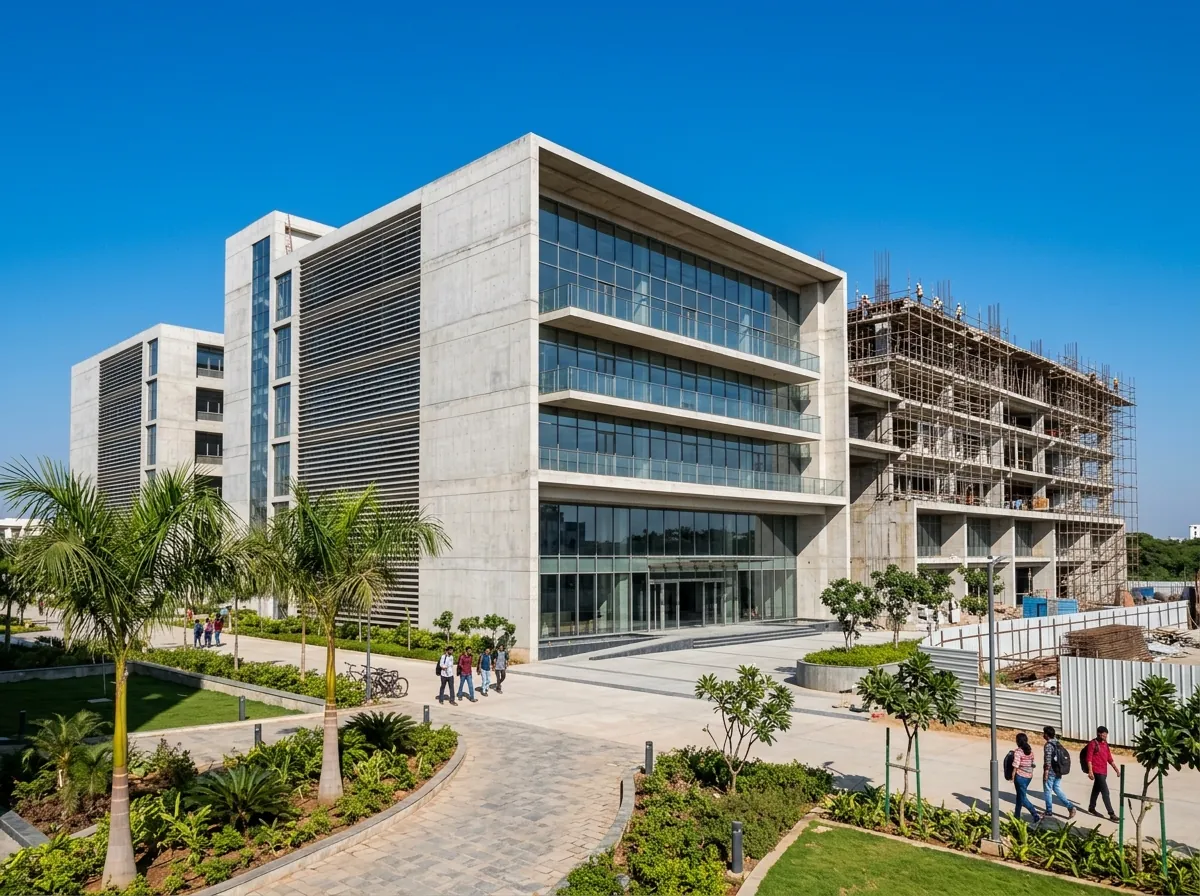
Commercial buildings have larger concrete volumes, heavier column loads, longer slab spans and harsher exposure. The steel has to deliver three things a house rarely asks for: higher yield strength, controlled ductility for seismic detailing, and traceability from melt to site.
The TMT process is what makes that possible. The hot bar is quenched with water to harden the outer layer, then the core self-tempers. The result is a strong outer rim over a tough, ductile core: a bar that carries heavy axial loads and still bends around a dense cage without cracking.
Cold-twisted bars do not give that combination. They lack the clear yield point and the bendability that modern commercial detailing needs.
Choosing the right grade for commercial projects
Grade is one of the first decisions a structural consultant makes. It sets the yield strength, the elongation and the UTS/YS ratio, and it drives the steel weight in the BOQ.
| Grade | Yield min | Elongation min | UTS/YS | Commercial use |
|---|---|---|---|---|
| Fe 500 | 500 N/mm² | 12% | ≥ 1.08 | Mid-rise towers, shopping complexes, standard RCC |
| Fe 550 | 550 N/mm² | 10% | ≥ 1.06 | High-rise, heavy-load columns, long spans |
| Fe 550D | 550 N/mm² | 14.5% | ≥ 1.08 | Seismic zones, ductile framing, metro and infrastructure |
Fe 500 is the workhorse for most mid-rise commercial buildings and IT parks. Fe 550 steps in when the design calls for higher strength, less steel weight or longer column-free spans. Fe 550D is the grade for earthquake-resistant structures, where ductility matters as much as strength.
When to specify Fe 550D for seismic zones
Under IS 1893, buildings in Seismic Zones III, IV and V are detailed for ductility to IS 13920:2016, in beam-column joints, shear zones and plastic hinge regions. IS 13920 asks for reinforcement with at least 14.5% elongation. Fe 550D meets that, with a 1.08 UTS/YS ratio.
If your project is in Zone III or above, or the consultant has specified ductile framing, buy the grade on the drawing. Do not substitute Fe 550 for Fe 550D.
Key technical features engineers specify
Durability for exposed and coastal structures
Commercial slabs, parking decks and roof terraces are exposed to weather, and in coastal cities to chlorides. Cover and concrete quality do most of the work here. Low sulphur and phosphorus in the steel help too, and Fe 550D has the tightest limits of our three grades: 0.075% sulphur and phosphorus combined.
Weldability and bendability on site
Commercial sites often weld and bend reinforcement on site. High carbon makes steel brittle at the weld. IS 1786 caps carbon at 0.30% for Fe 500 and Fe 550 and 0.25% for Fe 550D, so lap and butt welds can be made without pre-heating in most cases.
The bars must also bend around stirrups and hooks without surface cracks. RD TMT bars pass the IS 1786 bend and rebend test in every size from 8 mm to 32 mm.
Why commercial projects choose RD TMT
Commercial procurement buys on traceability, testing and delivery as much as on brand.
Every bar carries the ISI mark under licence CM/L-6200193709. Every batch is tested in our NABL accredited lab (NABLT0826KA18884). Each dispatch includes a test certificate tied to the heat number, so a bar on site can be traced back to its melt.
- NABL lab accreditation
- NABLT0826KA18884
- BIS licence, IS 1786
- CM/L-6200193709
- On every dispatch
- Heat number to test certificate
Our Fe 550 bars carry the CII GreenPro Ecolabel in all seven sizes (GPRDT496001 to GPRDT496007, valid till December 2027), and RD TMT bars are rated 5-star Green Steel by the Ministry of Steel at 0.63 tonnes of CO2 per tonne. For projects with IGBC, LEED or GRIHA targets, that paperwork is already on file. See our certifications.
Supply and bulk delivery for large projects
Commercial projects move in phases: foundations, basement slabs, floor-by-floor framing, roofing. Each needs different sizes and quantities. A supplier who misses the schedule stalls the project, and a stall costs far more than the steel margin.
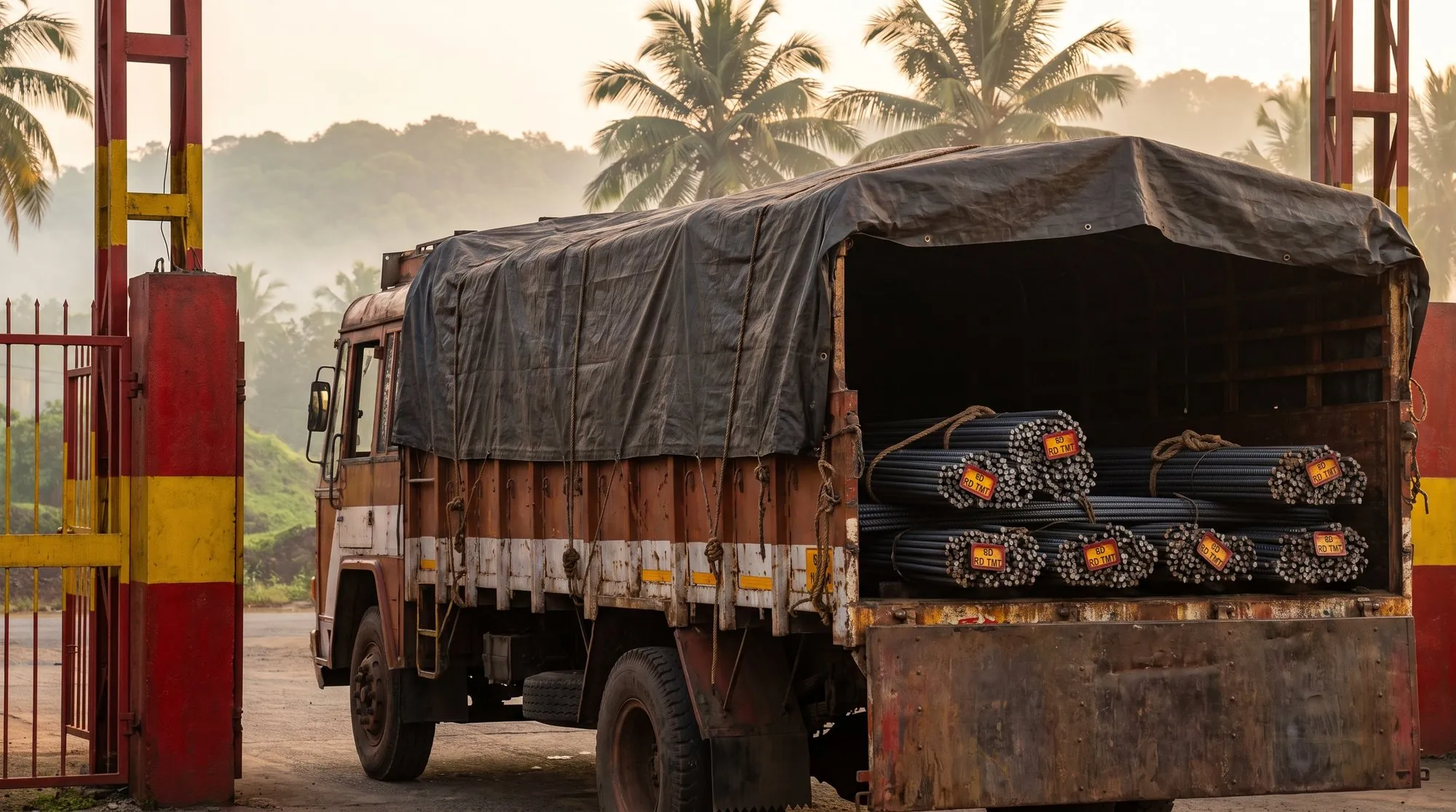
Our plant is in Mandya on the Bengaluru–Mysuru corridor, with our registered office in HSR Layout, Bengaluru. We deliver across Karnataka, Tamil Nadu and Andhra Pradesh. Bulk orders are quoted on quantity, size and the current market rate, with deliveries planned around your pour schedule. See bulk TMT bar supply.
For tenders, the test certificate goes with every dispatch. Copies of the BIS licence, the GreenPro certificate and the approval letters are available on request.
Compliance, testing and government approvals
- Approved by
- Tamil Nadu PWD, Karnataka Power Corporation, Bangalore Development Authority, Chennai Metro Rail and Karnataka PWD.
- Bought through tender
- KRIDL, DRDA Madurai and AP State Housing Corporation.
Each approval names its own scope. For example, the Tamil Nadu PWD approval covers Fe 550 bars, and the BDA approval covers Fe 550 and Fe 550D. Open each letter on the certifications page.
A procurement checklist for commercial TMT bars
Before you place a bulk order or sign off a delivery, run through these seven checks.
- Check the grade on the tag.
It should read Fe 500, Fe 550 or Fe 550D, exactly as the BOQ says.
- Verify the ISI mark.
Check the ISI mark on the bar and the licence number on the paperwork. Ours is CM/L-6200193709.
- Match the test certificate.
The heat number on the certificate must match the delivery. No certificate, no acceptance.
- Run a bend test.
The bar should bend to the set angle without surface cracking.
- Check the surface.
Look for seams, laps or deep rust pitting. Light mill scale is normal; cracks are not.
- Check size and weight.
Weigh a sample and check it against IS 1786 Table 1.
- Check the paperwork set.
Confirm you have the test certificate, and the GreenPro and BIS copies if the project needs them.
If any item fails, hold the delivery and ask for a replacement batch.
Frequently asked questions
What TMT grade is best for commercial buildings?
Fe 500 is the standard for most mid-rise commercial structures. Fe 550 suits high-rise towers, heavy-load columns and long spans. Fe 550D is the grade for seismic zones and ductile detailing.
What is the difference between Fe 500 and Fe 550 for commercial use?
Fe 550 has a higher minimum yield strength, 550 N/mm² against 500 N/mm², so a design can use less steel for the same load. It has slightly less elongation than Fe 500: 10% against 12%.
Do commercial projects need NABL test certificates?
Government tenders and large private developers usually ask for them. Every RD TMT dispatch carries a NABL lab test certificate traced to the heat number.
Is RD TMT approved for government projects?
Yes. Tamil Nadu PWD, KPCL, BDA, Chennai Metro Rail and Karnataka PWD have approved RD TMT bars, each with its own scope. KRIDL, DRDA Madurai and APSHCL have bought them through tender.
What is the minimum order for commercial bulk pricing?
It depends on the project schedule, size mix and tonnage. Send your requirement and we will quote within one business day.
Can TMT bars be welded on site?
Yes. IS 1786 caps carbon at 0.30% for Fe 500 and Fe 550 and 0.25% for Fe 550D, so lap and butt welds can be made without pre-heating in most cases.
How do I verify that TMT bars are genuine?
Check the ISI mark on the bar and the grade on the bundle tag, and match the heat number to the test certificate.
Does RD TMT supply Fe 550D for seismic commercial projects?
Yes. Fe 550D comes in 8 mm to 32 mm, with 14.5% minimum elongation and a 1.08 UTS/YS ratio, which meets the ductility IS 13920:2016 asks for.
How is delivery coordinated for large commercial sites?
We schedule dispatches around your pour calendar. Every load carries the NABL test certificate for its heat.