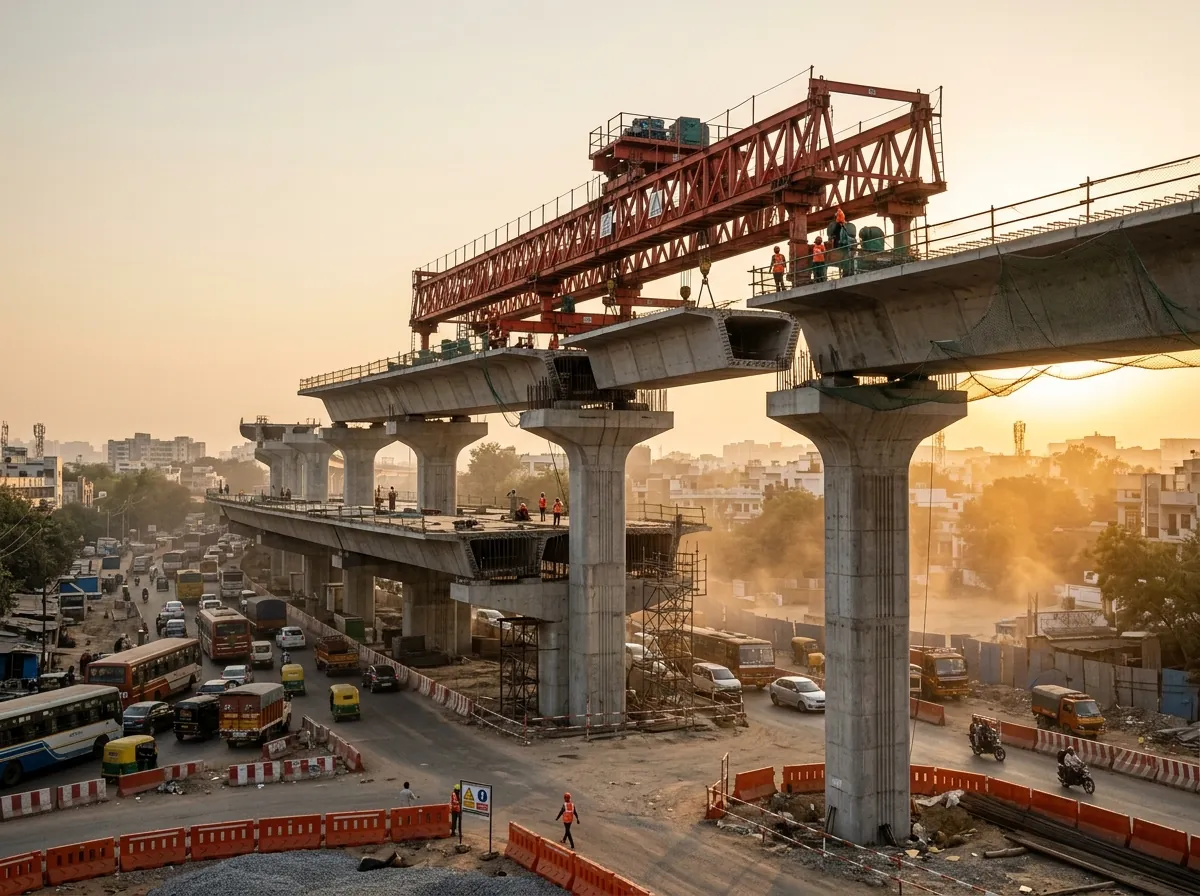
Why bridges are a different steel problem
A building’s load is mostly static. A bridge’s load moves. IRC:6 defines bridge loading by vehicle class, such as Class 70R, Class A and Class B, and adds an impact factor on top of the moving load. The load hits harder than it weighs.
- Seismic ductility, more often. Bridges in Zone III and above are where ductile detailing bites hardest, and where Fe 550D earns its place.
- Harsher exposure. Decks sit in the weather, approach slabs in water and mud, coastal structures in chlorides. Cover and low impurities do more work here than in a dry interior slab.
- Documentation. PWD and metro tenders run on mill test certificates, heat numbers and approved brand lists. A supplier who cannot produce them is not a supplier.
Choosing the right grade for infrastructure work
| Grade | Yield min | Elongation min | UTS/YS | Infrastructure fit |
|---|---|---|---|---|
| Fe 500 | 500 N/mm² | 12% | ≥ 1.08 | Approach slabs, water structures, low-load RCC |
| Fe 550 | 550 N/mm² | 10% | ≥ 1.06 | Girders, piers, heavy decks, long spans |
| Fe 550D | 550 N/mm² | 14.5% | ≥ 1.08 | Seismic-zone decks and piers, ductile detailing, metro |
Fe 500 handles the low-load RCC. Fe 550 carries the heavy elements. Fe 550D is the same strength as Fe 550 with more ductility, and it is the grade seismic detailing pushes you toward.
Grade selection by structure type
| Structure | Typical grade | Why |
|---|---|---|
| Road bridge or flyover, Zone III+ | Fe 550D | Ductile detailing, impact plus seismic |
| Road bridge or flyover, Zone II | Fe 550 | Heavy moving load, less ductility demand |
| Metro viaduct, elevated corridor | Fe 550 / Fe 550D | Deck live load, seismic detailing |
| Rail overbridge | Fe 550 | Heavy axle loads, dynamic impact |
| Retaining wall, underpass | Fe 550 | Earth plus surcharge load |
| Approach slab, abutment | Fe 500 / Fe 550 | Lower load, water exposure |
| Water tank, canal, utility | Fe 500 | Durability-driven, low load |
TMT specifications for infrastructure work
RD TMT makes all three grades to IS 1786:2008, the Indian Standard for high strength deformed steel bars for concrete reinforcement.
| Property | Fe 500 | Fe 550 | Fe 550D |
|---|---|---|---|
| Yield strength, min | 500 N/mm² | 550 N/mm² | 550 N/mm² |
| Tensile strength, min | 545 N/mm² | 585 N/mm² | 600 N/mm² |
| Elongation, min | 12% | 10% | 14.5% |
| UTS/YS ratio, min | 1.08 | 1.06 | 1.08 |
| Carbon, max | 0.30% | 0.30% | 0.25% |
| Sulphur, max | 0.055% | 0.055% | 0.040% |
| Phosphorus, max | 0.055% | 0.055% | 0.040% |
| Sulphur + phosphorus, max | 0.105% | 0.100% | 0.075% |
Every bar carries the ISI mark under licence CM/L-6200193709. Every dispatch leaves with a test certificate from our NABL accredited lab (NABLT0826KA18884), traceable to the heat number.
Sizes and weights
| Size | Weight per metre | Typical use |
|---|---|---|
| 8 mm | 0.395 kg/m | Ties and stirrups |
| 10 mm | 0.617 kg/m | Deck mesh, light RCC |
| 12 mm | 0.888 kg/m | Approach slabs, light girders |
| 16 mm | 1.580 kg/m | Deck slabs, beams |
| 20 mm | 2.470 kg/m | Girders, piers |
| 25 mm | 3.850 kg/m | Piers, abutments, heavy girders |
| 32 mm | 6.310 kg/m | Heavy piers, footings, mass concrete |
Bars come in 12 m standard length. See the full TMT bar sizes and weights.
What the codes actually require
- IS 456:2000, reinforced concrete: bar spacing, anchorage, and cover by exposure class.
- IRC:6, bridge loading: vehicle classes and the impact factor on moving loads.
- IRC:112-2011, code of practice for concrete road bridges.
- IS 1893:2016, seismic design: the zone decides how much ductility the detailing needs.
- IS 13920:2016, ductile detailing, which pushes the specification toward Fe 550D.
Cover is where infrastructure and buildings part ways. Decks, abutments and coastal structures take the higher end of the cover range because the chloride and water exposure is real. The grade on the bar and the cover on the drawing have to match the exposure.
How RD TMT makes bars for infrastructure
Quenched and self-tempered, not cold-twisted
Our bars are rolled on German TEMPCORE lines. The hot bar is quenched with water to harden the outer layer, then self-tempers from the core. A strong outer layer over a ductile core is what a deck under cyclic load and a pier in a seismic zone both need.
Every dispatch tested, every bar traceable
Every batch is tested in our own NABL accredited lab. Each dispatch carries a test certificate tied to a heat number, so a bar can be traced back to its melt. For a PWD or metro tender, that is the paperwork the committee and the supervising engineer ask for, batch by batch.
- NABL lab accreditation
- NABLT0826KA18884
- BIS licence, IS 1786
- CM/L-6200193709
- On every dispatch
- Heat number to test certificate
Durability where the environment is hard
- Low sulphur and phosphorus limit brittleness. Fe 550D has the tightest limits: 0.040% each, 0.075% combined.
- The quenched and self-tempered structure gives an even, crack-resistant surface that holds up under fatigue.
- Our Fe 550 bars carry the CII GreenPro Ecolabel (GPRDT496001 to GPRDT496007, valid till December 2027), and RD TMT bars are rated 5-star Green Steel, at 0.63 tonnes of CO2 per tonne and 71.22% greenness. That matters where a tender carries a green clause.
Where RD TMT bars go in infrastructure
Road bridges, flyovers and overpasses
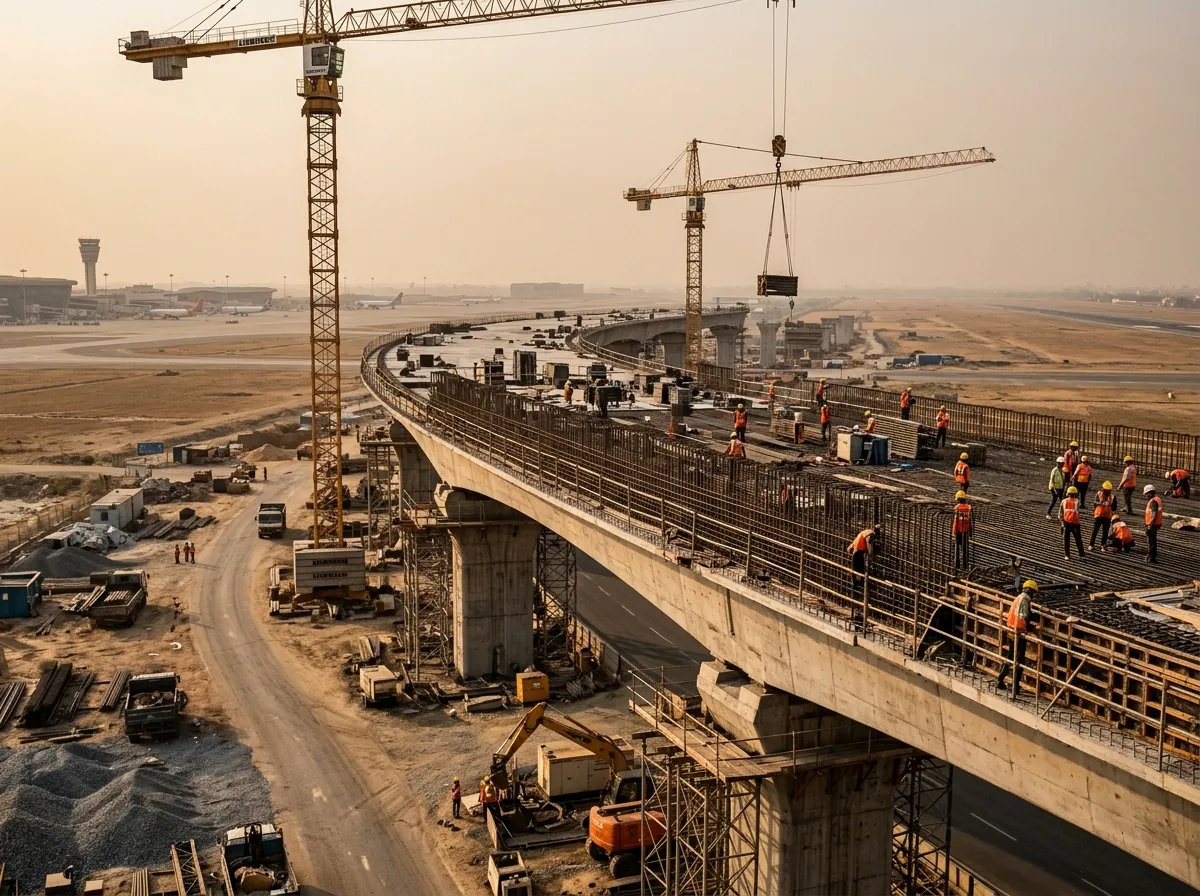
RCC girders, box girders, deck slabs, piers, abutments and approach slabs on PWD and private road projects. The Fe 550 or Fe 550D split follows the seismic zone and the load class on the drawing.
Metro and elevated corridors
Metro viaducts and elevated corridors are where Fe 550D shows up most. Chennai Metro Rail has given a no-objection for RD TMT bars in its projects.
Water and utility works
Tanks, canals, pipelines and utility structures, where durability and low-impurity chemistry do the work. KPCL has approved RD TMT steel for its works.
Approvals that name RD TMT
- Approved by
- Tamil Nadu PWD (Fe 550 bars), Karnataka Power Corporation, Bangalore Development Authority (Fe 550 and Fe 550D), Chennai Metro Rail and Karnataka PWD.
- Bought through tender
- KRIDL, DRDA Madurai and AP State Housing Corporation.
For NHAI or rail tenders, the approved brand list is set tender by tender. Check the current list for the specific tender before you bid. Open each approval letter on the certifications page.
Supplying infrastructure projects at scale
Infrastructure projects are phased and inspection-heavy: foundations and abutments, pier by pier, deck by deck. A supplier who cannot match the pour schedule stalls the project, and a stalled bridge costs far more than the steel margin.
Our plant is in Mandya on the Bengaluru–Mysuru corridor, with our registered office in HSR Layout, Bengaluru. Delivery is arranged to site, and every dispatch carries the NABL test certificate for its heat. Bulk orders are quoted on quantity, size and the current market rate. See TMT steel delivery.
For dealers supplying infrastructure work, the same traceability runs through: heat numbers, batch certificates and approval letters, so the dealer’s customer is not chasing paperwork at the gate.
An infrastructure steel checklist
- Check the grade on the tag.
It should read Fe 500, Fe 550 or Fe 550D, exactly as the drawing says.
- Check the ISI mark.
The ISI mark on the bar, and licence CM/L-6200193709 on the paperwork.
- Match the certificate.
The batch test certificate must match the heat number on the delivery.
- Run a bend and rebend check.
The bar must bend without cracking.
- Check size and weight.
Confirm the size and weight per metre against IS 1786 Table 1.
- Inspect the surface.
Look for cracks, deep scale or rust pitting.
- Check the approval list.
Confirm the brand is on the approval list for this tender and location.
- Hold what fails.
If any check fails, hold the delivery and ask for a replacement batch.
Frequently asked questions
What TMT grade is used in bridge construction?
Fe 550 for heavy-load elements in lower-seismic work, and Fe 550D where the code calls for ductile detailing in Zone III and above. Fe 500 handles approach slabs and water structures.
What is the difference between Fe 550 and Fe 550D for bridges?
Both have a 550 N/mm² minimum yield strength. Fe 550D stretches more, 14.5% against 10% elongation, with a 1.08 against 1.06 UTS/YS ratio and tighter chemistry. It is the grade for seismic and ductile detailing.
Is TMT used in prestressed bridges?
TMT is the reinforcement for the RCC elements: deck slabs, piers, abutments and approach slabs. Prestressing tendons are a separate high-strength steel system. The two are not interchangeable.
What loads does bridge reinforcement carry?
Moving vehicle loads per IRC:6, such as Class 70R, Class A and Class B, with an impact factor added on top of the static weight.
What cover is required for bridge reinforcement?
Cover is set by exposure class in the design code. Decks, abutments and coastal structures take the higher end because of chloride and water exposure. Follow the drawing.
Is RD TMT approved for government infrastructure projects?
Tamil Nadu PWD, KPCL, BDA, Chennai Metro Rail and Karnataka PWD have approved RD TMT bars, each with its own scope. For NHAI or rail tenders, check that tender’s approved brand list.
What documentation does a bridge tender require?
Usually the BIS licence, NABL test certificates per heat, heat-number records and the brand approval for the tender. RD TMT sends the test certificate with every dispatch.
What sizes are used in bridge decks and girders?
12 to 16 mm in decks and light girders, 20 to 25 mm in piers and heavy girders, 25 to 32 mm in mass concrete and footings, and 8 to 10 mm for ties and stirrups.
How do I get a quote?
Send the grade mix, the size breakdown and the quantity schedule. We will quote for delivery to your site in Karnataka, Tamil Nadu or across South India.