What a late or damaged load costs you
A delayed load does not only cost the days it is late. Every trade behind the pour moves back with it.
- Labour
- The bar-bending crew is on site and paid whether the steel arrives or not.
- Shuttering
- Formwork stays up and holds the working area until the steel is placed.
- Concrete slot
- Ready-mix slots are booked ahead. A missed pour is a window you pay for and cannot reuse.
- Crane
- A crane booked for unloading is reassigned, or charged anyway.
Damage and replacement
A bundle that arrives bent, badly rusted or in the wrong length has to be replaced and rescheduled. The replacement rarely arrives as fast as the original order. None of this shows in the per-tonne rate.
Steel is a scheduling input
Contractors who run tight programmes give the pour date first and work back from it. Steel has to be on the ground before shuttering closes and the concrete slot opens, so the delivery date is set by the pour, not by the day the order was placed.
From the pour date, four things follow: when the bars are rolled, when they are dispatched, which vehicle fits the lane, and how the bundles are unloaded.
How a delivery works, step by step
- Enquiry.
You give the grade, sizes, quantity and delivery location. We confirm availability and the current rate.
- Specification check.
We check the grade against your drawing. If the structure needs Fe 550D and the enquiry says Fe 500, we say so before the order is confirmed.
- Production or stock.
Bars are rolled to specification at the mill or taken from finished stock, then bundled, strapped and tagged.
- Quality test.
Samples from the batch are tested in our NABL accredited lab. The results become the test certificate for that heat.
- Dispatch.
Loads leave the plant Monday to Saturday on the vehicle that fits your site.
- Transit.
Along the Bengaluru–Mysuru Expressway (NH-275) and into the city’s industrial and residential corridors.
- Delivery at site.
To the work front or to your gate, depending on what the site can take.
- Documents.
The test certificate, GST invoice and delivery challan are handed over, all traceable to the heat number.
Documents are the step buyers ask about least and need most. They are what a structural consultant or a government auditor checks.
Delivery vehicles and site access
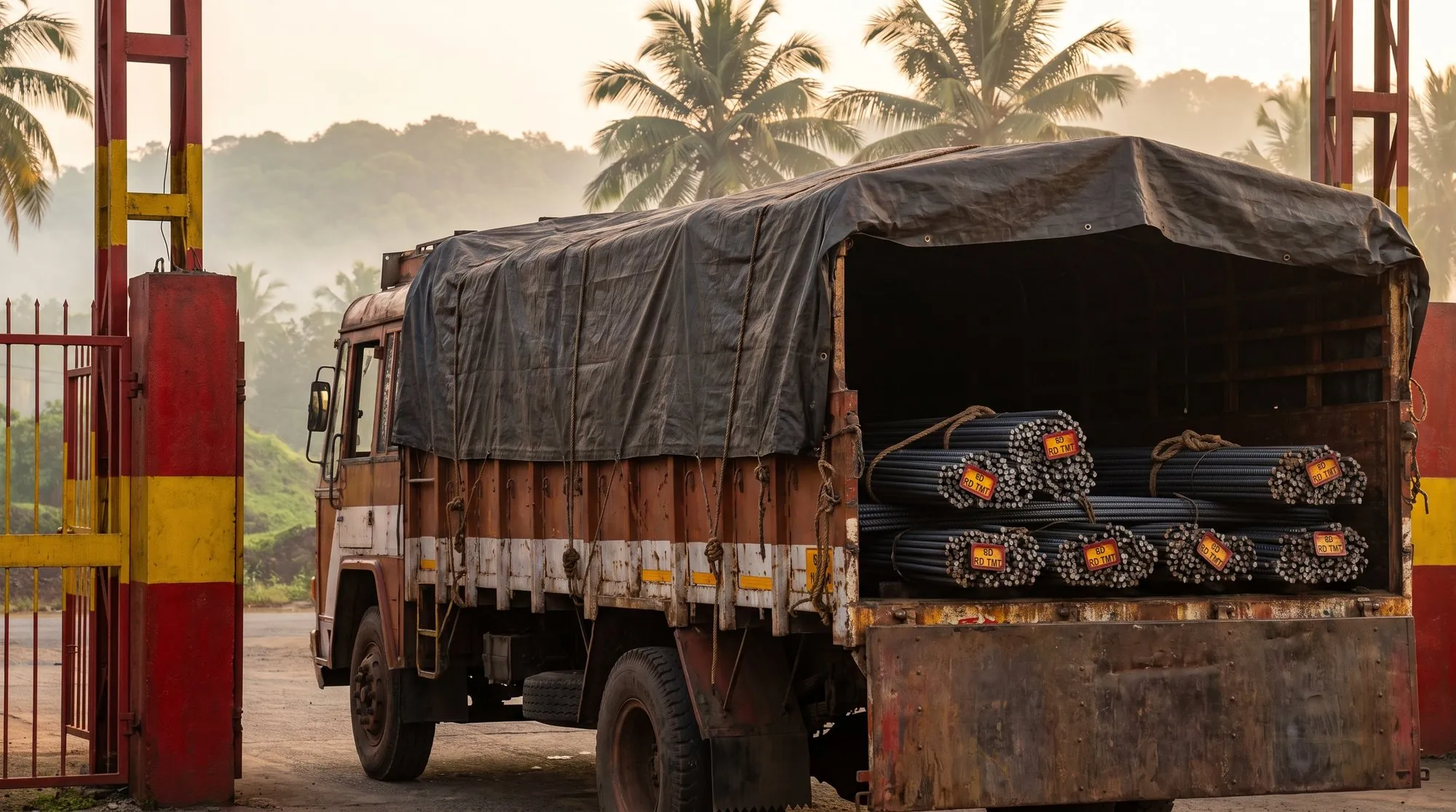
TMT bars ship in strapped bundles at 12 m standard length, and a full load runs to several tonnes. The vehicle has to match both the tonnage and the access at your gate.
| Vehicle | Typical load | Best for |
|---|---|---|
| Small truck | Smaller loads | Tight urban plots, narrow lanes, part loads |
| Truck | 10–14 tonnes | City sites, shorter hauls, standard pours |
| Multi-axle truck or trailer | 14–25 tonnes | Bulk orders, longer distances, large sites |
A 12 m bundle cannot turn into a narrow lane the way a smaller vehicle can. Tell us the lane width, gate width and crane access when you order, and we plan the vehicle for the access, not only for the tonnage.
Unloading arrangements
- Manual unloading works for smaller loads where labour is on hand, but 12 m bars need several hands and care.
- A crane or Hiab is needed for tight sites, high stacks or large bundles. It has to be on site, or we schedule around the one you have arranged.
- A forklift or trolley suits yards and warehouses with level access.
Settle the unloading method when you confirm the order. If it is not settled, our team will advise on what your site can take.
Where we deliver
Why the plant location matters
Our plant is on the Bengaluru–Mysuru Expressway (NH-275) at Somanahalli, Mandya, about 80 km from the city, which keeps the run predictable. Our registered office is in HSR Layout, Sector 3. Being close to both the plant and the market lets us set delivery windows against your pour schedule.
We deliver direct from the plant to sites and dealers. Our bars have gone into the Bengaluru Airport taxiway, DS-MAX Towers and the JSS AHER Global Campus in Mysuru, and we have supplied government housing through KRIDL, DRDA Madurai and APSHCL tenders. See the projects we supply.
Areas we run into every week
| Corridor or area | What we deliver into |
|---|---|
| Peenya | Industrial sheds, warehouses, factory structures |
| Nelamangala and Bidadi | Highway work, logistics parks, RMC plants |
| Harohalli and Bommasandra | Industrial units, institutional campuses |
| HSR–Sarjapur belt | Villas, apartments, low-rise commercial |
| Mandya and Mysuru | Government housing, institutional and highway projects |
Sites outside these areas can still be served, with a longer lead time. We also deliver across Tamil Nadu and Andhra Pradesh.
What comes with each load
The paperwork is how you prove afterwards what was supplied. When a consultant asks what grade a bar is, the answer has to be a document.
- Test certificate
- From our NABL accredited lab, showing the chemistry and strength of the batch, traced to its heat number.
- GST invoice and delivery challan
- For your accounts and input tax credit, and a record of what left the gate and what arrived.
- NABL lab accreditation
- NABLT0826KA18884
- BIS licence, IS 1786
- CM/L-6200193709
- On every dispatch
- Heat number to test certificate
The bars carry the RD TMT name and the ISI mark, and the bundle tag carries the grade and heat number. Our bars are made to IS 1786:2008 under BIS licence CM/L-6200193709. Our Fe 550 bars carry the CII GreenPro Ecolabel, valid till December 2027, and RD TMT bars are rated 5-star Green Steel at 0.63 tonnes of CO2 per tonne. See our certifications.
Checking a load at the gate
- Count and weigh.
Compare the bundles against the challan. Weigh a sample where you can.
- Check the tag.
The bundle tag should show the grade, Fe 500, Fe 550 or Fe 550D, and the heat number.
- Check the bar.
The bar should carry the ISI mark and the maker’s name. Reject unmarked bars.
- Inspect the surface.
Straight bars, even ribs, no heavy rust or bends.
- Verify the length.
Standard bars are 12 m. Confirm yours match what the drawing assumes.
- Keep the certificate.
File it with the batch details. It is the proof if anyone questions the steel.
Morning deliveries leave time to inspect, unload and fix a problem before the crew finishes. If the project needs a green rating or a government tender, ask for the GreenPro and BIS copies when you order.
Frequently asked questions
How does TMT steel delivery work in Bengaluru?
You give us the grade, sizes, quantity and delivery location. We confirm availability and rates, roll or take the bars from stock, test the batch, and dispatch from our plant in Mandya on a vehicle suited to your site. The load arrives with a test certificate, GST invoice and challan.
How fast can you deliver?
It depends on the grade, size mix and quantity. Stocked sizes can go quickly; a specific grade or a bulk order is planned around your schedule. Send the requirement and we will give a realistic timeline.
Can your vehicles reach my site?
Tell us the lane width, gate access and whether a crane can enter, and we plan the vehicle for the access.
Who arranges unloading at the site?
It depends on the load and the site. Small loads can be unloaded by hand; large or tight sites need a crane, Hiab or forklift. We advise on what fits and can schedule around a crane you have arranged.
What documents do I get with each load?
A test certificate from our NABL accredited lab traced to the heat number, a GST invoice and a delivery challan.
Do you deliver outside Bengaluru?
Yes. We deliver across Karnataka, Tamil Nadu and Andhra Pradesh from our plant in Mandya. For large projects we can plan pan-India delivery.
Is there a minimum order for delivery?
It depends on the grade, size mix and site. Send the quantity you need and we will quote within one business day.
How are delivery charges worked out?
They depend on distance, vehicle and load size. Ask for a delivered-to-site price and we will quote it.
Can you plan phased deliveries?
Yes. For high-rise, industrial and infrastructure work we plan phased deliveries to match the pour schedule, so steel arrives as each stage is ready.